Your nail salon's price list,
always current
You bump the price of a gel manicure and the screen changes itself — no fixing the card on the mirror. While your client waits or dries, she watches a designs lookbook and reaches the station knowing what she wants — often with nail art she hadn't planned. You run it from your phone between clients.
First screen free forever · No card · Offline 48 h
Design of the month + nail art from +£5
What you put on screen
from day one
Templates ready for the neighbourhood salon and the urban nail bar. No design, no learning curve.
Service prices, always current
GEL MANICURE £18 · ACRYLIC NAILS £35 · PEDICURE £25 · SOAK-OFF £8 · NAIL ART from +£5. When you change a price or add a service, you push it from your phone and the screen updates in 2-3 seconds.
Designs and colours lookbook
French, baby boomer, chrome, seasonal sets. The client browses styles while she waits and picks hers without describing it. It's the case that lifts the ticket most: from a plain gel to nail art.
Queue and who's next
Who's up next and the rough wait. Whoever walks in sees if it's soon without asking. You keep working the nail without looking up.
Deal of the month, products and your Instagram
The summer pedicure deal, the cuticle-care kit on sale, and your best work or your Instagram on loop. You fill gaps in the diary and sell product without pitching it at every appointment.
The plan your
nail salon needs
A small salon with one screen: Starter €9/mo. With a waiting screen (lookbook) plus a price-list screen at the stations: Pro €19/mo (3 screens, the popular one). A larger salon: Business €59/mo. A multi-site chain: Network €199/mo. All with a 14-day trial, no card.
No card · Cancel anytime · See all plans
Where the screen goes
in the nail salon
A nail salon sells the design and lifts the ticket with gel. Each screen works a part.
Window and waiting
The design lookbook — French, baby boomer, chrome effect, seasonal designs — on rotation. The client browses styles while she waits and arrives at the station with a clear idea, often a more elaborate design than the one she came in with.
Work stations
The treatment menu with prices: gel manicure, acrylic nails, pedicure, soak-off, nail art. With the price of each technique clear, the client goes for the gel or the design without having to ask for everything.
Waiting area
The queue and who is next, with the approximate wait. The walk-in sees whether her turn is coming without having to ask "who's last?", and it keeps the room in order at the Saturday peak.
Retail area
The offer of the month, the cuticle-care kit or the oil on sale, and your Instagram with your best work. The client who looks after her nails takes the aftercare product home, and your feed turns the walk-in into a follower.
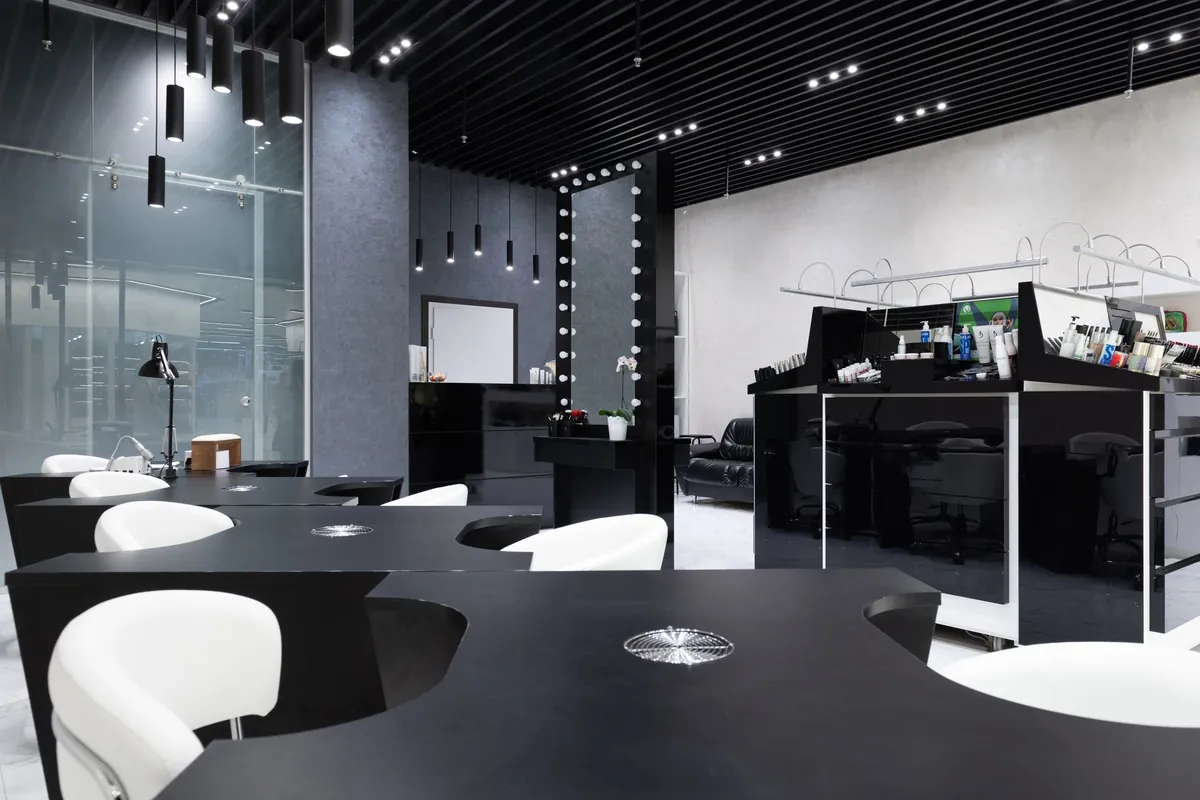
The lookbook sells the design,
the gel brings them back
A nail salon lifts the ticket with the design it shows and retains with gel and acrylics. The screen works both.
The lookbook lifts from the basic to the design. The client who sees a good French, a chrome effect or a seasonal nail art on screen asks for that design, not the basic manicure. Showing your best work while she waits raises the ticket naturally: the same station time becomes a higher-value treatment, and the client arrives decided on what she has seen rather than on the minimum.
Gel and acrylics are the recurrence. Gel lasts about three weeks and acrylics need infills: that expiry is what brings the client back like clockwork. Having the treatments and their prices clear at the station pushes towards the technique that lasts — and that retains — over regular polish, and turns a one-off visit into a client who comes every three weeks.
Retail and socials close the circle. The client who looks after her nails wants the cuticle oil or the aftercare kit that makes her manicure last, and buys it if she sees it in the retail area. And your Instagram on screen turns the walk-in who came in to ask into a follower, which is how a new client finds your salon today. The screen joins the work, the product and the socials.
To be straight with you: we do not manage the bookings or the queue. If you use Booksy, Treatwell or Fresha, you carry on with them; the screen shows the turn and the approximate wait, but the booking stays in your app. Digisini is the screen layer that shows the design, lifts to gel and sells the aftercare product.
Everywhere else a wall competes with a phone
here the phone is the one thing she cannot pick up
Sitting still is common. Being unable to use your hands is not. For the length of a gel set and the curing that follows, a client cannot hold a phone, turn a page, reach into a bag or check a calendar — and that is a situation no other business in this list has.
Which turns the usual advice upside down. In a shop window you have three seconds and one message; a supermarket screen is losing an argument against a phone before it starts. Here there is no argument to lose, so the room's mistake is not being too wordy — it is running a loop of short promotions through the one stretch of attention nobody else gets.
What earns that time is not another design. It is the two things that decide whether she comes back and when:
- What makes it last twelve days instead of five. Oil, gloves for cleaning, not using a nail as a tool, how long before a bath. It reads as care rather than selling, and it is also the honest version of a retail pitch — because the client who gets twelve days rebooks on a schedule, and the one who gets five blames the salon and tries another.
- What to do when one breaks on day three. This is the moment the salon is either called or replaced, and almost nobody prepares for it. Say what to do, whether a repair is charged, and how fast you can fit one in. It costs nothing to write, and it is the difference between a phone call to you and a search for whoever has a slot.
And there is an operational consequence of the same forty minutes that is easy to miss: for the last stretch she also cannot pay, cannot get a card out, and cannot open her calendar to agree a date. Anything that needs her hands has to happen before the colour goes on, or it happens badly at the door with everyone waiting. A salon that moves rebooking and payment to the start of the appointment is not being pushy — it is the only point in the visit where those things are physically possible.
The same constraint sets the format. Nothing that needs a QR code scanned on the spot, nothing that asks her to type, nothing that disappears in six seconds. If she wants to act on it, she will act forty minutes from now — so it has to still be there, or be something she can be handed on the way out.
Common questions
from salon owners
Your first screen,
live this afternoon.
First screen free forever. No card. No installers. Offline 48 h.
Start free →14-day trial on paid plans, no card · Cancel anytime
Take the button via email
We'll send a 1-click link to create your account whenever you want. No password, no card, no commitment. Your first screen FREE forever.
No spam. Just the link — you decide when to come in.