Your clinic's waiting room,
that explains the treatment
The patient comes in for hard skin and waits, staring at their phone. Instead of a TV showing the news, they see how a gait analysis and custom orthotics fix the knee pain they've been carrying, and how to care for a diabetic foot. They leave asking about the biomechanical assessment. You change it all from your phone.
First screen free forever · No card · Offline 48 h
Custom orthotics · routine foot care £30 · diabetic foot
What you show on screen
from day one
Templates ready for the high-street clinic and the sports podiatry lab.
Services and prices, always current
ROUTINE FOOT CARE £30 · INGROWN TOENAIL · GAIT ANALYSIS · CUSTOM ORTHOTICS · DIABETIC FOOT. When you change a price or launch a package, you push it from your phone and the screen updates in 2-3 seconds.
Gait analysis and orthotics
The biomechanical assessment and custom orthotics, explained with a before/after of the pain. The patient who came in for hard skin understands that their knee or back problem starts at the foot, and asks about the assessment. It's the service that lifts the average sale the most.
Prevention, diabetic foot and reminders
Home care, diabetic foot, the right footwear and review reminders. You educate the at-risk patient, cut complications and fill the diary with reviews, the backbone of the clinic's repeat business.
A calming feel + hours and reviews
Calm visuals that ease the wait, your opening hours, your phone and your real reviews. A more relaxed waiting room makes first visits easier and patients more confident.
The plan your
clinic needs
Small clinic with 1 screen in the waiting room: Starter €9/month. Clinic with a waiting-room screen + a reception or treatment-room screen: Pro €19/month (3 screens, the most popular). Larger clinic with several rooms and a gait lab: Business €59/month. Multi-site chain: Network €199/month. All with a 14-day trial, no card.
No card · Cancel anytime · See all plans
Where the screen goes
in the podiatry clinic
In podiatry the waiting room closes the gait analysis and prevention retains. Each screen works a part.
Reception
The services and prices: routine treatment, ingrown toenail, gait analysis, custom orthotics, diabetic foot. The patient sees the full menu and discovers services they had not thought of when they came for a corn.
Waiting room
The biomechanical gait assessment and the custom orthotics, explained with a before/after. Seeing how a corrected gait changes is what makes the patient ask about the assessment, which is the clinic's highest-value service.
Treatment room
The visual support to explain the treatment: what a routine treatment is, how an ingrown toenail is corrected, how an orthotic is made. The patient who understands their treatment engages and accepts better what they see explained.
Prevention area
The home care, the diabetic foot, the right footwear and the review reminders. Educating on prevention adds value, retains and opens the door to ongoing follow-up, especially for the diabetic patient.
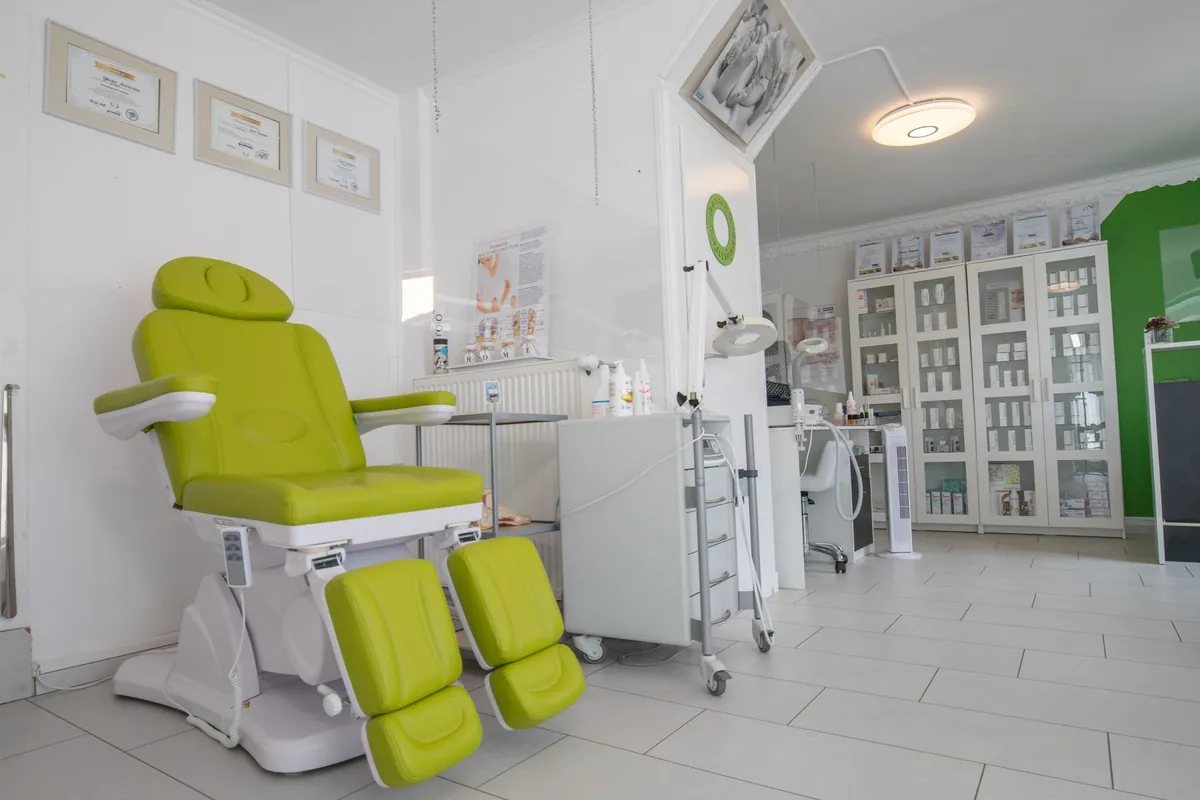
The waiting room closes the orthotics,
prevention retains
A podiatry clinic grows with the gait analysis and orthotics, and with ongoing follow-up. The screen works both.
The before/after of the gait closes the assessment. The biomechanical assessment and the custom orthotics are a podiatry clinic's highest-value service, and hard to sell with words alone. Showing in the waiting room a before/after of a corrected gait makes the patient see the problem and the solution, and ask about the assessment in the treatment room. The high-value conversation is opened by the patient.
Prevention retains and creates follow-up. Educating on home care, the right footwear and the diabetic foot adds a value the patient perceives and appreciates, and opens the door to ongoing follow-up. For the diabetic patient, that follow-up is not just recurring business, it is health: the review reminders on screen keep the monitoring that prevents serious complications.
Making services known broadens the treatment. Many patients come for a corn or an ingrown toenail and do not know you also do gait analysis, orthotics or diabetic-foot follow-up. Showing the full menu at reception reveals services the patient needed and did not know you offered, and broadens the treatment of the one you already have in, without reception having to list them.
To be straight with you: we do not integrate with your clinic software (TM3, Cliniko, Pabau). The screen shows the services, the gait analysis and the advice you upload, with the patient's consent for the before/after; the management and records stay in your system. Digisini is the screen layer that closes the assessment and retains with prevention.
A large share of the people who need you most
physically cannot see their own feet
Not figuratively. Someone who is eighty, or carrying weight, or has a stiff back or a poor hip cannot bend far enough to look at the sole of their own foot, and often cannot reach it either. That single fact explains most of what walks through a podiatry door too late — and it is the one thing no other clinic's waiting room has to design around.
So the useful content is not «check your feet» — it is how to check them at all. A mirror flat on the floor. Photographing the sole with a phone, which most people have never thought of and which works. Asking whoever helps with the shopping to look once a week. Feeling inside the shoe with a hand before putting it on, because a stone or a rucked seam does its damage to a foot that cannot feel it. These are twenty-second instructions and they are the difference between a problem found at a fortnight and one found at three months.
And there is an entitlement almost nobody in that room knows they have. Anyone living with diabetes should be getting their feet checked every year, and a great many are not — either it was never offered, or it was offered as a line in a longer appointment and did not register as a thing with a name. Putting that on the wall costs a sentence, does not sell anything, and is the single most valuable thing a podiatry waiting room can say: the whole point of that check is to catch what the patient cannot see.
The wall is also where the title problem gets settled, and it is worth settling. Anyone may offer foot care; only registrants may call themselves a podiatrist or chiropodist. From a pavement the two are indistinguishable, and the patient has no idea the distinction exists, let alone that it can be checked in a minute on a public register. Naming who is treating them, with their registration, is not boasting — it is the only fact in the room the patient can verify, and it costs nothing to display.
One thing to keep off the screen, though: photographs of feet. The clinical before-and-after that closes a gait assessment belongs in a private conversation, not on a wall in a room with strangers in it — for the patient in the picture and for the person waiting with a sandwich. Diagrams do the explaining just as well, and the difference between a clinic that understands that and one that does not is visible from the door.
To be straight with you: we are a screen, not a clinical service. What a foot check involves and who is entitled to what is between the patient, their GP and your own professional body — the point here is only that the person in your waiting room may genuinely never have seen the underside of their own foot, and that nothing on the wall usually accounts for it.
Common questions
from podiatrists
Your first screen,
live this afternoon.
First screen free forever. No card. No installers. Offline 48 h.
Start free →14-day trial on paid plans, no card · Cancel anytime
Take the button via email
We'll send a 1-click link to create your account whenever you want. No password, no card, no commitment. Your first screen FREE forever.
No spam. Just the link — you decide when to come in.