Your clinic's waiting room,
that closes treatments
The patient comes in for a hygiene visit and sits there tense, waiting. Instead of a TV showing the news, they see real before/after clear-aligner cases and the implant at £25/month with finance. They leave asking for a quote on the treatment they'd been putting off for months. You change it all from your phone.
First screen free forever · No card · Offline 48 h
from £49/month · implant £25/month · free first visit
What you show on screen
from day one
Templates ready for the high-street practice and the implant & orthodontics clinic.
Treatments and finance, always current
IMPLANT from £25/month · CLEAR ALIGNERS from £49/month · WHITENING · VENEERS · HYGIENE. Finance on screen removes the price barrier. When you change a price or a payment plan, you push it from your phone and the screen updates in 2-3 seconds.
Before/after that closes cases
Real cases of cosmetic dentistry, aligners and implants (with patient consent). Someone waiting for a check-up sees the result, pictures themselves and asks for a quote. It's what lifts the clinic's average treatment value the most.
Check-up reminders and free first visit
6-month check-up and hygiene, free first consultation, home care. You win back the patients who stop coming and fill the diary with check-ups, the backbone of the clinic's recall.
A feel that eases the fear + hours and emergencies
Calm visuals that lower dental anxiety, your opening hours, the emergency phone and your real reviews. A more relaxed patient says yes to treatment more easily.
The plan your
clinic needs
Small clinic with 1 screen in the waiting room: Starter €9/month. Clinic with a waiting-room screen + a reception or surgery screen: Pro €19/month (3 screens, the most popular). Larger clinic with several chairs and orthodontics: Business €59/month. Multi-site group: Network €199/month. All with a 14-day trial, no card.
No card · Cancel anytime · See all plans
Where the screen goes
in the dental clinic
In a dental clinic the waiting room is not dead time: it is where the higher-value treatments are closed. Each screen works one lever.
Reception
The treatments with monthly finance: implants from £25/month, clear aligners from £49/month, whitening, veneers. Showing the monthly payment, not the total, is what turns a £1,200 implant into an affordable decision.
Waiting room
The before/after of real cases (with patient consent) and an ambience that eases dental anxiety. The patient who sees well-resolved veneers or clear aligners asks about that treatment in the chair.
Surgery
The visual support to explain the treatment chairside: how an implant works, the stages of aligner treatment, the whitening technique. The patient understands and accepts better what they see explained than what they only hear.
Reception till
The recall reminder for a check-up and hygiene every six months, the free first consultation and the finance plans. Paying is when the next appointment is booked and the patient who had drifted away is reactivated.
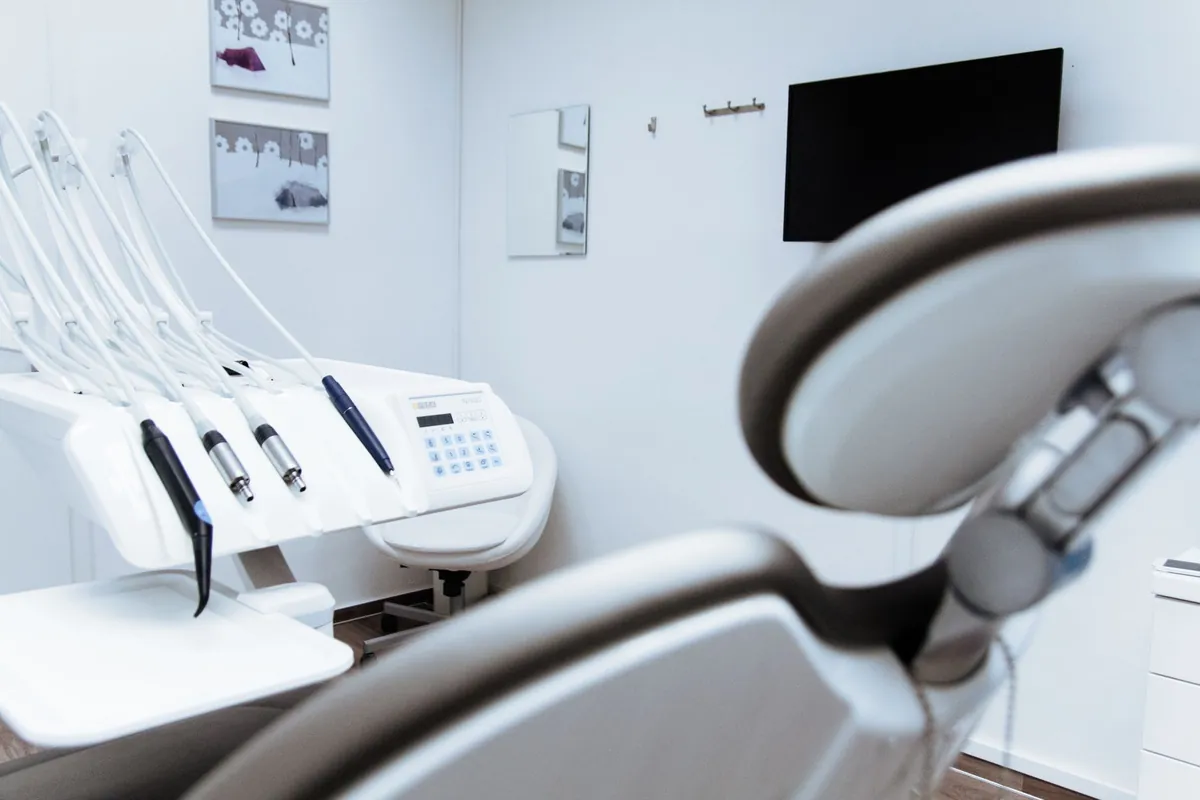
The waiting room
closes treatments
A dental clinic grows on the high-value treatments — implants, orthodontics, cosmetic — and on winning back the patients who stopped coming. The screen works both.
Before/after is the clinic's best salesperson. Nothing sells a cosmetic dentistry treatment like the result. The patient who waits and sees a real case of veneers or clear aligners — well resolved, with consent — asks about it in the surgery. It is the conversation that opens the high-value treatment, and the patient opens it, not you.
Finance removes the price barrier. The patient does not turn down the implant over £1,200, they turn it down over how it sounds. Showing "from £25/month" turns a figure that frightens into an affordable monthly decision, and lifts take-up of the treatments that carry the clinic. The monthly payment on screen does that work before the patient even enters the surgery.
Winning patients back fills the quiet diary. The reminder for a check-up and hygiene every six months reactivates the patient who drifted away. It is the cheapest way to fill gaps: patients who already know you and just needed the nudge. And the ambience that eases dental anxiety stops the nervous ones putting it off indefinitely.
To be straight with you: we do not manage appointments or the patient record. If you use Dentally, SOE or Software of Excellence, you carry on with them; Digisini is the screen layer that closes treatments and wins patients back. Before/after is handled with the patient's signed consent, in your folders.
Most people in that room
are doing arithmetic, not dreading the chair
Dentistry is the one area of health here where the patient is constantly, quietly trying to work out what this is going to cost and whether they are on the NHS or private today. They rarely ask, because asking about money in a waiting room feels like admitting something. So they guess — and people who guess about cost mostly guess «later».
Two facts settle most of that, and neither is a sales message. The first is that an NHS course of treatment is charged as a band, not per item: three fillings in the same course is one charge, not three. Patients who have not been in for years often believe the opposite and ration their own treatment accordingly, agreeing to the urgent tooth and leaving the other two — which is exactly the decision that brings them back in pain a year later.
The second is the one almost nobody claims: NHS dental treatment is free during pregnancy and for a year after the baby is born. Also for under-18s, and for people on certain benefits or on a low income through the exemption scheme. The maternity one is the striking case, because it lands precisely when money is tightest and when nobody has spare attention to go looking for entitlements. A single line on the wall reaches a person who would never have asked, and it costs the practice nothing at all.
And a third, which is counter-commercial and therefore believed: six months is not a rule. Recall intervals are meant to be set by risk, and for a low-risk adult that can be a good deal longer. Saying so out loud sounds like turning away business, and it does the opposite: it is the clearest possible signal that the recommendations in this practice are clinical rather than commercial, and it makes every later recommendation land harder. A patient who has been told once that they do not need something believes the next time they are told that they do.
All of which changes what the wall should lead with. Before-and-after cases sell the treatments, and they should stay — but they work on the person who has already decided to be here and is at ease. The money questions come first, because they are what the room is actually thinking about, and a waiting room that answers them without being asked has already done the hardest part of the appointment before the patient sits down.
To be straight with you: we display what you upload, and charges and exemptions change. What band a treatment falls into, and who is exempt this year, is settled by the NHS and your practice manager — the point here is only that these are the questions the room is silently asking, and that almost no waiting room answers them.
A screen in reception is advertising,
whatever you meant it to be
Anything shown on a screen a patient can see counts as marketing to the public, not as a conversation in the chair. That single distinction settles most of what belongs in the loop — and the before-and-after photo is where it bites first.
The simplest test is the newspaper test
If a claim would not be acceptable in a printed advert, it does not become acceptable because it is on your own wall in a room full of people who already booked. The screen has the reach of an advert and the informality of a poster in the staff room, and only the first of those is what the rules look at. That is not a reason to keep the screen dull — it is the reason to keep it factual, which in this room is also what works.
Before-and-after images are conditional, not forbidden
They are allowed and they are useful, with conditions that catch most practices out. The images must be your own patients and genuinely comparable — same lighting, same angle, no retouching — and they must not suggest that this is what a typical patient gets. The usual failure is not dishonesty, it is a pair that is not comparable, shot months apart on two different phones. And consent matters twice over: agreeing to «a photo for the practice» is not the same as agreeing to appear on a screen in reception that a neighbour walks past. Ask for consent to the place, not just to the picture.
The one thing in that room a patient can check
Names and GDC registration numbers for the clinicians, and who regulates the practice. It reads as bureaucratic and it is the strongest slide in the loop, because it is the only claim on the screen that the person sitting there can verify from their phone before they are called in. Everything else asks for trust; this one offers proof. It also ages well — it is the slide that never needs rewriting when the offers change.
The categories where the line has moved
Cosmetic injectables are the clear case: advertising them to the public has been restricted, and a waiting-room loop is exactly the surface that counts as advertising to the public. Whitening, implants and aligners each carry their own claim wording, and the rules around all of this have tightened rather than relaxed. Worth ten minutes with the current guidance before the playlist is built, rather than after a complaint — because the slide is trivial to remove and the letter is not trivial to answer.
Common questions
from dentists
Your first screen,
live this afternoon.
First screen free forever. No card. No installers. Offline 48 h.
Start free →14-day trial on paid plans, no card · Cancel anytime
Take the button via email
We'll send a 1-click link to create your account whenever you want. No password, no card, no commitment. Your first screen FREE forever.
No spam. Just the link — you decide when to come in.