Your massage menu,
always current
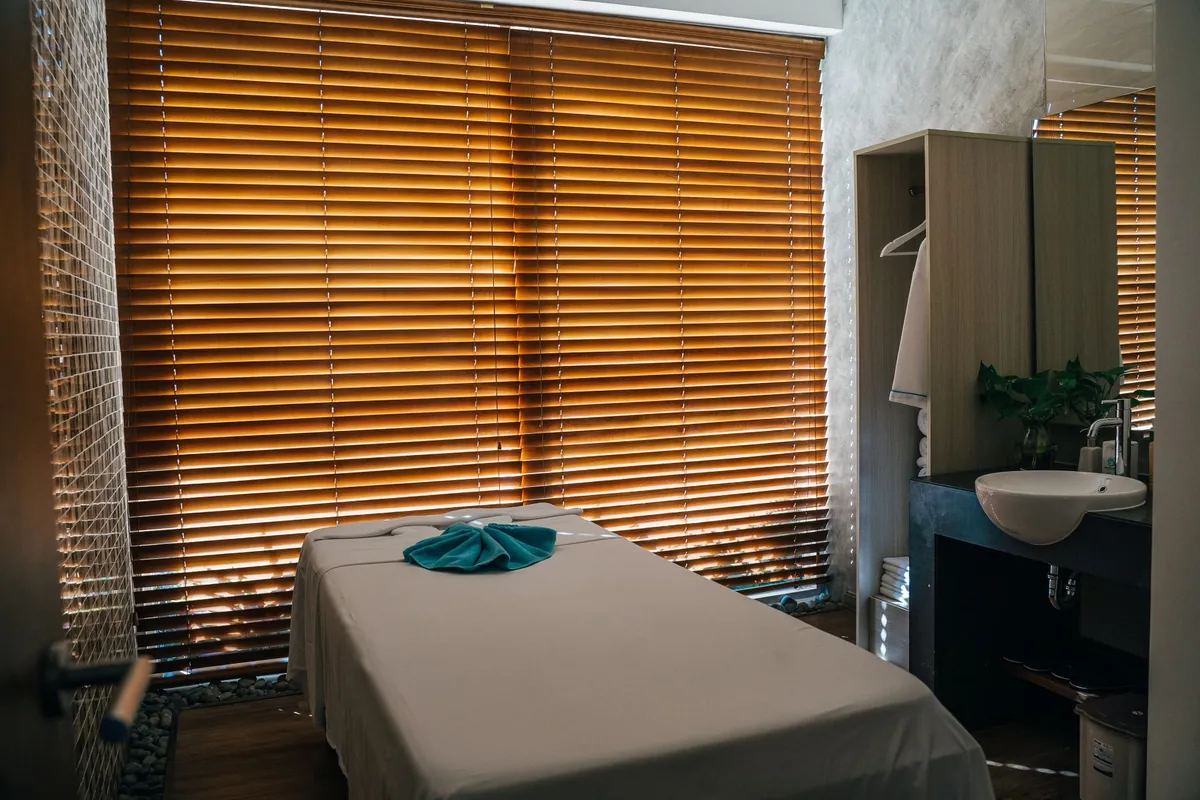
Your client walks in with a stiff back and, instead of a TV running the news, sees an ambience that already starts to settle them. At reception the menu is clear: relaxing, deep tissue, sports — with duration and price. You change it from your phone between tables.
First screen free forever · No card · Offline 48 h
5-session pass · -15%
What you put on screen
from day one
Templates ready for the neighbourhood centre and the massage spa. No design, no learning curve.
Massage menu and prices, current
RELAXING 50 min £45 · DEEP TISSUE 30 min £30 · SPORTS 50 min £50 · LYMPHATIC 60 min £55. When you change a price or add a technique, you push it from your phone and the screen updates in 2-3 seconds.
Pass of the month and packs
A 5-session pass at a discount, a gift voucher, a seasonal offer. You show it at reception while the client pays — when loyalty is easiest to win. No reprinting leaflets.
Calm ambience in the waiting room
Soft images and music on loop instead of a news channel. The client walks in and starts to let go before the table. The massage begins working before you touch the back.
Aftercare, oils and reviews
The aftercare tips (hydration, stretches), the oils and creams on sale and your best reviews on loop. You sell retail and reinforce the result without explaining it every time.
The plan your
centre needs
A small centre with one screen at reception: Starter €9/mo. With a reception screen plus an ambience screen in the waiting room: Pro €19/mo (3 screens, the popular one). A larger centre or spa with several rooms: Business €59/mo. A multi-site chain: Network €199/mo. All with a 14-day trial, no card.
No card · Cancel anytime · See all plans
The one place with a captive audience
who cannot see anything at all
In a nail salon the client is held still and looking. In a waiting room they are sitting and reading. Here they are face down with their eyes shut for fifty of the sixty minutes. It is the only room in this whole list where the audience is completely captive and completely unreachable — which settles a question most centres get wrong.
The treatment room gets nothing
Not a calmer version, not ambient imagery, nothing. Anything on a wall in there is either unseen or a glow through closed eyelids, and the second is worse than the first. The wall belongs to reception and the corridor — and knowing that before installing saves the awkward conversation where the screen is moved a month later.
Everything useful happens before
And it is the first-timer's entire anxiety, which almost nobody writes down: what comes off and what stays on, how the draping works, whether they are expected to talk, what to say if the pressure is too much. People do not ask these — they just do not book. Four lines in reception convert more first appointments than any offer.
And the rest happens in the five minutes after
The client comes out slow, warm and not entirely present, and that is exactly when rebooking either happens or does not. Whatever you want from them then has to require almost nothing: a date already suggested, a price already known, no form. Asking someone in that state to make a decision from scratch is asking them to say «I'll message you».
The corridor, not the room, is where the course is sold
A knot or a sports problem is not fixed in one session, and the client who stops after two concludes it did not work. The place to say what the second and third sessions actually change is the corridor they walk twice — before, when they are still deciding, and after, when they have just felt the difference.
The client cannot tell you apart from a clinic
and saying so plainly is the strongest thing on your wall
Massage, physiotherapy and medical treatment sit next to each other in a customer's head, and the words used to sell them online have blurred to the point of being interchangeable. The person booking does not know which one they need, and they are not going to ask — so they either pick wrongly or they do not book at all.
The centre that draws the line first, in writing, wins the people who were looking for exactly that sentence. What is done here, what is not, and who to see when the answer is no. It is the hardest information to find in the whole sector and the cheapest to give — and it does not sound like modesty to a reader, it sounds like competence.
Saying no sends one person away and brings three back. Somebody who arrives asking for something not done here leaves either way; the difference is whether they leave with a name and an address or with the feeling of not having understood. Referral is the only advertising other people do for you — and it runs in both directions, because the practitioner you send someone to has the same problem in reverse.
And it changes what the course means. «Six sessions» sold as a package is a commercial offer; «this usually takes about six sessions and here is what changes by the third» is the same six sessions described as a treatment. The second closes more, holds longer, and produces almost none of the arguments the first one does when somebody stops at two.
In all honesty: we do not handle your bookings or your diary. The screen shows the menu, the limits and what you load, and you update it from your phone. And where exactly the line falls for your qualifications is a question for your professional body, not for this page — here it only matters that the line, written where people read it, is the best argument a serious centre has.
A gift voucher is money taken in December
for work you will do in February — and for some of it, work you will never do at all
It is the healthiest cash position this business gets and the easiest one to misread. The money is in the account before anything has been delivered, which looks like a very good December and is in fact a January and February already partly spoken for. Read as profit it produces a small crisis in spring; read as a booking curve it does the opposite, because it lands in the quietest weeks of the year and fills them without a single discount.
The redemption pattern is predictable enough to plan around. A cluster arrives in the first weeks of January, another as the expiry approaches, and a residue never comes at all. Knowing roughly how those three portions split for your own centre is worth more than any forecast, and it takes one afternoon with last year's records. It changes what you do in January: not a discount to fill the gap, but a reminder to the people who are already holding one.
Which brings the awkward case, and it is worth deciding before it happens rather than at the counter. Someone arrives with a voucher that expired last month. Refusing is defensible and costs more than it saves, because the person standing there is usually not the person who bought it — they were given a present, and what they will remember is being turned away. The workable position, written in advance, is the one most centres arrive at anyway after doing it badly once: the amount paid still stands towards a session, and whatever promotional extra came with it does not.
Written where vouchers are actually sold, that policy does a second job. The buyer, in December, is the one person who genuinely wants to know the terms, because they are buying something for somebody else and do not want to hand over a problem. A clear line at that moment sells more vouchers rather than fewer — and it is the same line that prevents the conversation in March.
To be straight about it: we do not issue or track vouchers, and what your terms say is yours to set — the screen shows what you type. We raise it because it is the one piece of a massage centre's year that is decided months before it happens, and because the version that goes wrong is always the one nobody had written down.
Common questions
from centre owners
Your first screen,
live this afternoon.
First screen free forever. No card. No installers. Offline 48 h.
Start free →14-day trial on paid plans, no card · Cancel anytime
Take the button via email
We'll send a 1-click link to create your account whenever you want. No password, no card, no commitment. Your first screen FREE forever.
No spam. Just the link — you decide when to come in.