The mum who asks
"is this right for my 7-year-old?"
She walks in holding her kid, looks at a sign with old timetables and can't tell if there's a children's class or when. Instead of a faded poster, she sees the 5:30pm kids' karate, the belt progression and this week's free trial class. She signs the kid up before leaving. You change the term's schedule from your phone.
First screen free forever · No card · Offline 48 h
Tue & Thu 5:30pm · free trial class this week
What you put on screen
from day one
Ready-made templates for the neighbourhood dojo and the multi-mat centre with several disciplines.
Schedule by discipline and age
Kids' karate, adult BJJ, kickboxing, taekwondo and self-defence — each class with its time, level and age range. The parent who walks in can see at a glance when there's a class for their child. When you change the term's timetable, you push it from your phone and the screen updates in 2-3 seconds.
Belt progression and grading dates
The full belt progression, the requirements for each grade and the date of the next exam. The student sees the path ahead and stays to reach the next belt; the parent understands there's a method and a goal. This is what cuts mid-term dropouts — Sensei David sees it every time gradings go up on screen.
Free trial class, fees and values
The free trial class, the monthly fees and the values you teach: discipline, respect, self-defence. The undecided parent who only came to ask books the trial — and the trial is where the enrolment is decided. You turn a quick question into a new student.
Competitions, instructors and reviews
Upcoming competitions and displays, your students' podium results, a short intro for each sensei and instructor, and your real reviews. A school with a track record and a teacher with a face and a name gives a parent the confidence to leave their child there.
The plan your
school needs
Small school with 1 screen at reception: Starter €9/mo. School with a reception screen plus a mat screen: Pro €19/mo (3 screens, the most popular). Larger centre with several mats and disciplines: Business €59/mo. Multi-site school group: Network €199/mo. All with a 14-day trial, no card.
No card · Cancel anytime · See all plans
Where the screen goes
in the dojo
In a martial arts school reception wins the sign-up and the mat keeps the member. Each screen has a different job.
Reception and entrance
The screen that wins the membership. The parent walking in with a child sees the kids' karate timetable, this week's free trial class and the fees in twenty seconds, without asking or waiting for a class to finish. This is where the new member is won or lost, so it is the first screen you would put up.
Next to the mat
The belt progression, the requirements for each grade and the date of the next grading. Between rounds the student looks at the wall and sees the path to the next belt; that visible progression is the best cure for the post-holiday drop-off.
Parents' waiting area
While the little one trains, the parents watch. That is where the values you teach go — discipline, respect, self-defence — plus your students' competition podiums and the seminar with a guest master. A parent who sees a school with a track record renews without a second thought.
Corridor and changing room
Schedule reminders, sign-ups for gradings and seminars, and the kit for sale: gi, boxing gloves, shin guards, mouthguard. The screen sells the gear without the instructor having to stop and sell between classes.
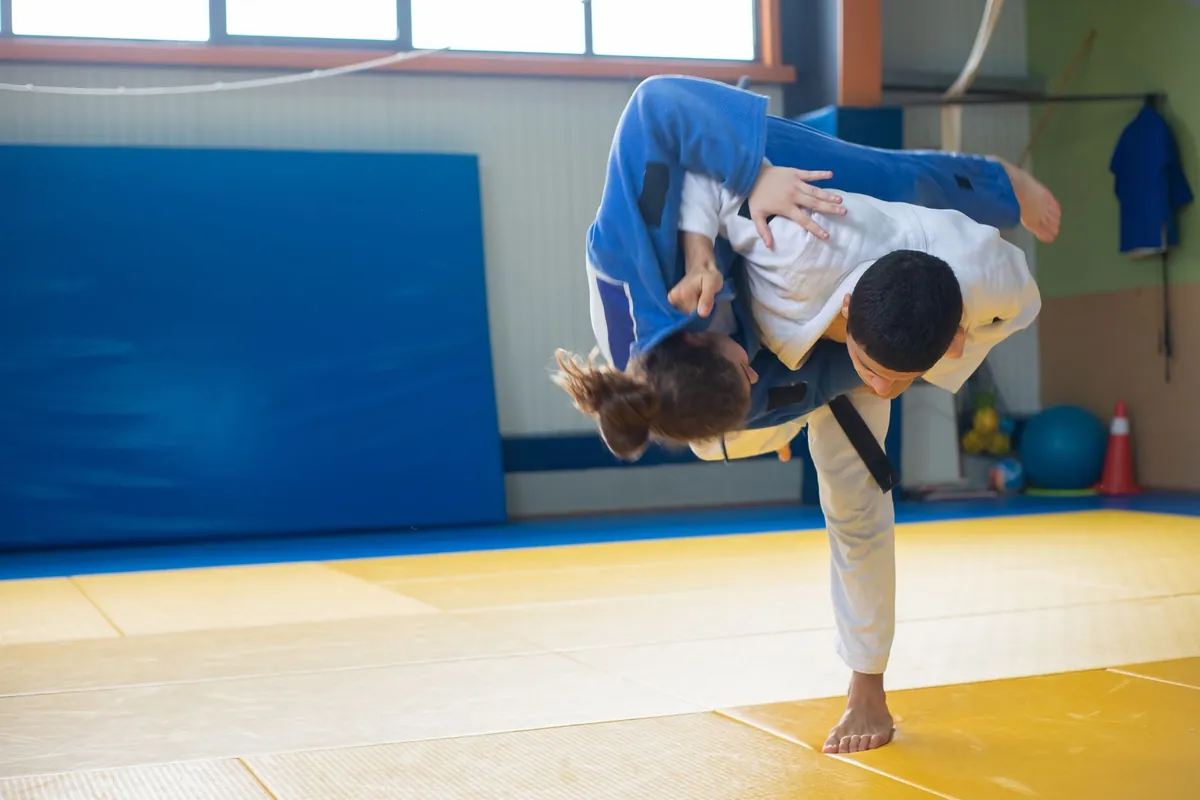
Win the kids, keep them by belt:
that is the dojo business
A martial arts school does not live on the drop-in class; it lives on kids' enrolment, renewal by progression and the income from gradings and seminars.
The undecided parent decides at reception. They walk in holding the child's hand, and in those first twenty seconds they decide whether to try or go away to think about it. A faded printed poster loses them; a screen with the 5.30pm kids' karate, the free trial and "discipline and respect from age 4" converts them. Kids' enrolment is what carries the books.
Visible progression keeps members. Drop-off in martial arts comes on the plateaus — when the student sees no progress. Having the belt wall and the next grading on screen, next to the mat, keeps the goal in sight: the student who can see the next belt hangs on to the grading. Retention is cheaper than recruitment, and this works it on its own.
Event income fills up when it is announced. Gradings, seminars with a guest master, in-house competitions, summer camps. Announced weeks ahead on the screen — not in a WhatsApp group nobody reads — they fill up. And the kit (a new gi, protective gear, gloves) sells at the edge of the mat, right when the student realises they need it.
To be straight with you: we do not manage fees, grades or attendance. For your school software (Kicksite, Zen Planner, Spark Membership) you carry on as you are; Digisini is the screen layer that wins, keeps and announces, not a membership management system.
Class ends at half past six.
Two children are still there at twenty to seven, and nobody has ever said out loud who is responsible for them
Every kids' club has this gap, and almost none of them have written anything about it. A parent is stuck in traffic, the instructor is already teaching the adult session, and two nine-year-olds are sitting on the bench by the door in the dark. It works — until the evening it does not, and then the question of who was supposed to be watching is asked for the first time in the worst possible circumstances.
Writing the rule down is not bureaucracy: it is the only version of it that protects everyone. Two lines on the wall by the door — when the mat is supervised until, where children wait, and the number to ring if you are running late — turn an unspoken assumption into something both sides agreed to. Parents read it in week one instead of finding out in month six, and the instructor stops having to decide, alone and mid-session, whether to walk a child outside.
The version that actually gets followed is the one with a time in it. « Please collect by 6:45 » works; « please be punctual » does not, because it asks for a virtue instead of naming a moment. And the tone matters as much in a club as it does anywhere else: families who are late are usually late for reasons they cannot control, so a line that says what happens — « we'll wait with them inside, just call » — buys more goodwill than one that scolds, and gets the phone call that solves it.
There is a second reader for the same wall, and it is the one who never asks: the parent deciding whether to sign up at all. Whether the instructors are checked, who the club's safeguarding contact is, and what happens if a child is hurt are the questions that sit behind « I'll think about it ». Very few people will ask them across a reception desk, and a club that answers them on the wall, plainly, has removed a doubt it never knew it was carrying.
Straight about the boundary: what a club must have in place — checks, insurance, a named contact, first aid — is set by your governing body and the law where you are, and it is nothing to do with us. We are not the ones to tell you what those obligations are, only that the ones you already meet are almost always invisible to the families paying you.
Common questions
from instructors and school owners
Your first screen,
live this afternoon.
First screen free forever. No card. No installers. Offline 48 h.
Start free →14-day trial on paid plans, no card · Cancel anytime
Take the button via email
We'll send a 1-click link to create your account whenever you want. No password, no card, no commitment. Your first screen FREE forever.
No spam. Just the link — you decide when to come in.