Your counter communicates on its own,
you dispense in peace
The neighbourhood pharmacist updates queue numbers, the flu campaign and parapharmacy offers from her phone between customers. The window TV keeps running after you close: out-of-hours rota and the nearest open pharmacy.
Free first screen forever · No credit card · No technician
COUNTER 2 · Repeat prescription
Four screens for
a pharmacy that actually dispenses
Queue, seasonal health, parapharmacy and rota. Four contents the pharmacist controls from her phone while serving.
Queue at the counter
«QUEUE 142 · COUNTER 2». Sync with your queue system via public API (Pro+ plan) or update manually from your phone in 3 seconds. Customers know where to go, you don't shout numbers.
Seasonal health campaigns
Flu shots from October 1 to December 31. Hydration and sun care May to September. Hand-washing all year. Programme the dates once and screens switch on the exact day on their own.
Parapharmacy on promo
Dermo-cosmetics, vitamins, seasonal lines. Change prices and offers between customers from your phone. Shelves stay intact, the screen becomes the dynamic window display you never had.
Out-of-hours rota
At night with the pharmacy closed, the window TV keeps glowing with the duty rota and the nearest 24h pharmacy. It keeps informing when you're already home.
An independent pharmacy
starts with Starter €9/mo
One screen in window or counter, no watermark, all content editable from your phone. If you also have parapharmacy with waiting area jump to Pro €19/mo (3 screens). Local chains with 10 stores: Business €59/mo. 14-day trial on every paid plan, no commitment.
No card · Cancel anytime · See all plans
Where the screen goes
in the pharmacy
A pharmacy communicates on its own so the pharmacist can dispense calmly, sells the OTC lines and gives an out-of-hours service. Each screen covers a zone.
Counter
The queue — "NOW SERVING 142 · TILL 2" — synced with your queue system, by number and never by name. It takes the pressure off the counter and the pharmacist dispenses calmly, without the constant "who's next?".
Window
The seasonal health campaigns — the flu jab from autumn, sun care and hydration in summer — and, at night, the out-of-hours information with the nearest open pharmacy. The lit window gives a 24-hour service.
Health & beauty area
The skincare, the vitamins and the seasonal lines on offer, with price. It is the pharmacy's free margin — no prescription, no fixed price — and the screen sells it without the counter, busy dispensing, having to offer it.
Waiting area
The health advice, the prevention campaigns and the services (blood pressure, tests, medicines review). It educates the patient and makes known the professional services many do not realise you offer.
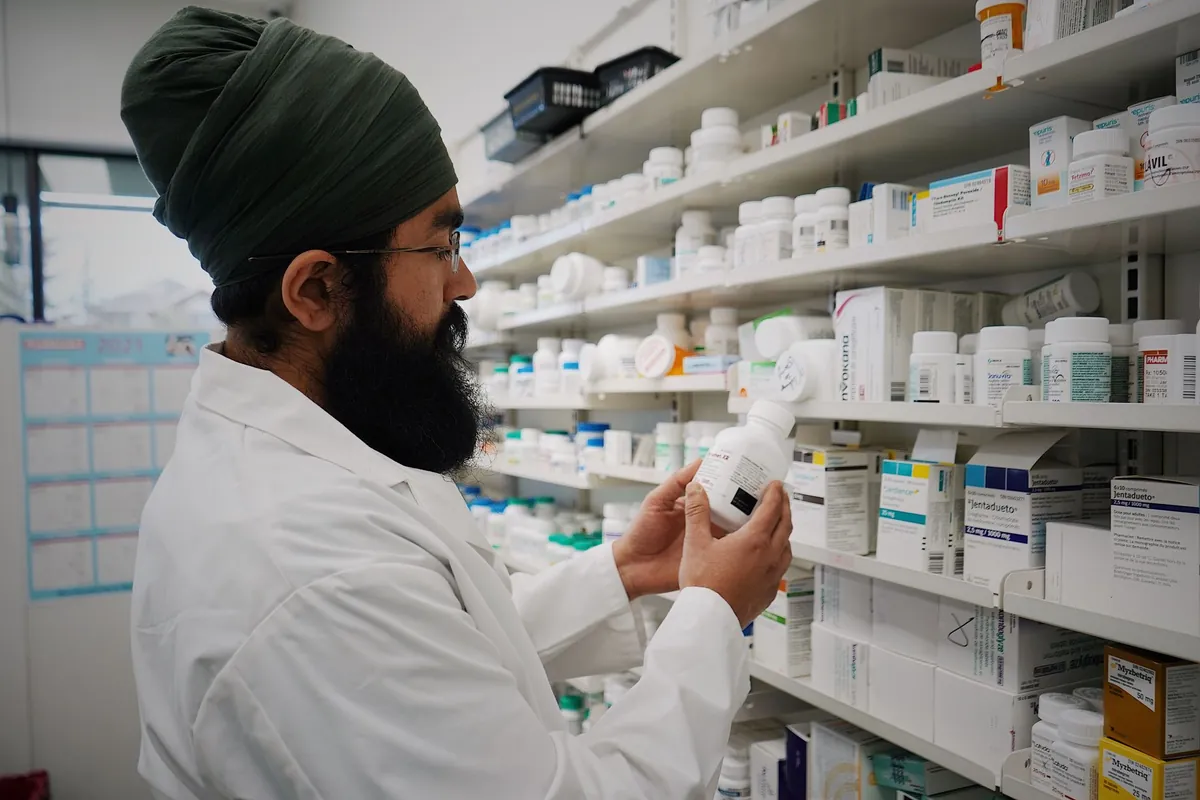
The counter communicates on its own,
you dispense calmly
A pharmacy takes the pressure off the counter with the queue, sells the free margin of health & beauty and gives an out-of-hours service. The screen works all three.
The queue offloads the counter and respects privacy. "NOW SERVING 142 · TILL 2" by number, never by name: the patient knows when it is their turn and the pharmacist dispenses calmly, without the constant "who's next?" interrupting. It syncs with your queue system, so you do not run two of everything, and patient privacy is covered because the screen shows only a number.
Health & beauty is the free margin, and it sells in view. Medicines have a fixed price; the skincare, the vitamins and the seasonal lines do not. That is the margin that carries the books, and it sells when it is seen: a screen in the health & beauty area with the month's offer places the product without the counter — busy dispensing — having to offer it.
The out-of-hours service serves and captures. At night, with the pharmacy closed, the lit window with the opening times and the nearest out-of-hours pharmacy is a real service to the neighbourhood at the moment someone needs it, and keeps your pharmacy present and visible. The seasonal campaigns — flu, sun care, hay fever — are scheduled by date and the screen runs and clears them on its own.
To be straight with you: we do not manage dispensing, the prescription system or stock. The queue does sync with your system via its API; the rest of the content you upload. Digisini is the screen layer that offloads the counter, sells health & beauty and runs campaigns, not a pharmacy management system.
Half the people waiting for a GP appointment
are waiting for something that could be dealt with here, today
Community pharmacies can now assess and treat a defined list of common conditions, and supply what is needed for them without anyone seeing a doctor first. It has been possible for a while and it is still, for most of the public, a well-kept secret — so people take a day off work, sit in a surgery, and arrive at the pharmacy afterwards for the same medicine they could have had before lunch.
Writing the list where people stand is the whole intervention. Not a paragraph about the service — the conditions themselves, in the words people use, with who it applies to and what to ask for at the counter. Somebody standing in the queue with a sore throat reads it and asks. Somebody who has to already know the scheme exists in order to ask about it will never ask, which is exactly why the service is underused in the places that need it most.
The same goes for the room at the back that almost every pharmacy has. Most customers assume it is storage or an office, so they discuss a rash at the counter, quietly, with two people behind them — or they say nothing and leave. A line that says there is a private room, that it is free, and that anyone can ask to use it changes what people are willing to bring in. It is the cheapest possible increase in what a pharmacy can actually help with.
Then there is the money one, which nobody hears about anywhere else: the prepayment certificate. Anybody paying for prescriptions regularly is very likely paying more than they need to, and the arithmetic is simple enough to put on a screen — above a certain number of items a year, the certificate costs less than the items. The people it would help most are precisely those who never asked, because asking about cost in a health setting feels like admitting something.
And all three share a property that makes them ideal wall content: none of them sells anything. They send people to a free service, into a free room, or to a cheaper way of paying — which is why they are believed, and why the pharmacy that publishes them becomes the one people ask first. In a trade where the same products sit on every high street at the same price, being asked first is the entire competitive position.
To be straight with you: we display what you upload and we provide no clinical or eligibility advice. Which services your pharmacy offers, and who qualifies for what, is set by the NHS and your own team — the point here is only that these three things exist, that the people they would help do not know about them, and that the queue at your counter is the one place they would read them.
What the
neighbourhood pharmacist asks us
Start today.
Your window TV has been off for too long.
Free first screen forever. No credit card. No technician. The neighbourhood pharmacist updates queue, health campaigns and parapharmacy from her phone in 5 minutes.
Start free14-day trial on paid plans · Cancel anytime · Public API on Pro+
Take the button via email
We'll send a 1-click link to create your account whenever you want. No password, no card, no commitment. Your first screen FREE forever.
No spam. Just the link — you decide when to come in.