Your best sourdough,
sold with a coffee at £2.50
A customer walks in for a loaf and walks out with a coffee, a croissant and a cake for Saturday. Instead of a chalkboard with yesterday's prices, they see your coffee + croissant combo at £2.50, the custom birthday cake for this weekend and the pain au chocolat fresh from the oven. They leave with more than they came for. You mark sold-out from your phone.
Free first screen forever · No card · 48h offline
Breakfast £2.50 · custom cakes · gluten-free
What you put on screen
from day one
Ready-made templates for a neighbourhood bread shop and for a patisserie with a bakery and café.
Daily specials with prices
Your loaf, sourdough, croissant, pain au chocolat and cakes, each with its price. When the rye bread runs out or the afternoon batch comes out of the oven, mark it from your phone and the screen updates in 2-3 seconds. Nobody asks for something that’s gone.
Custom cakes and made-to-order
Birthday, communion and celebration cakes with a photo and a QR to order without queuing. The person who came for a loaf sees this weekend’s cake and orders it. It’s your highest-margin product and fills the bakery on weekdays when counter sales are slower.
Breakfast and afternoon combos by time of day
Morning coffee with croissant at £2.50, afternoon pastries, and end-of-day discounts to reduce waste. The screen switches automatically at the times you set. You increase average ticket and fill those quiet mid-afternoon hours.
Allergens, baked-on-site, opening hours and reviews
Clear allergen info, your baked-on-site and sourdough badge, opening hours and real customer reviews. Coeliac customers find their bread without asking, and passers-by trust a place that shows what it does. You tick allergen compliance too.
The plan
your bakery needs
Small bakery with 1 screen above the counter: Starter €9/month. Bakery with counter screen + window display: Pro €19/month (3 screens, most popular). Bakery with café and multiple zones: Business €59/month. Multi-site bakery chain: Network €199/month. All with 14-day trial, no card.
No card · Cancel anytime · See all plans
Where the screen goes
in the bakery
A bakery raises the ticket with the combo and captures the high-value order. Each screen works one of the two.
Counter
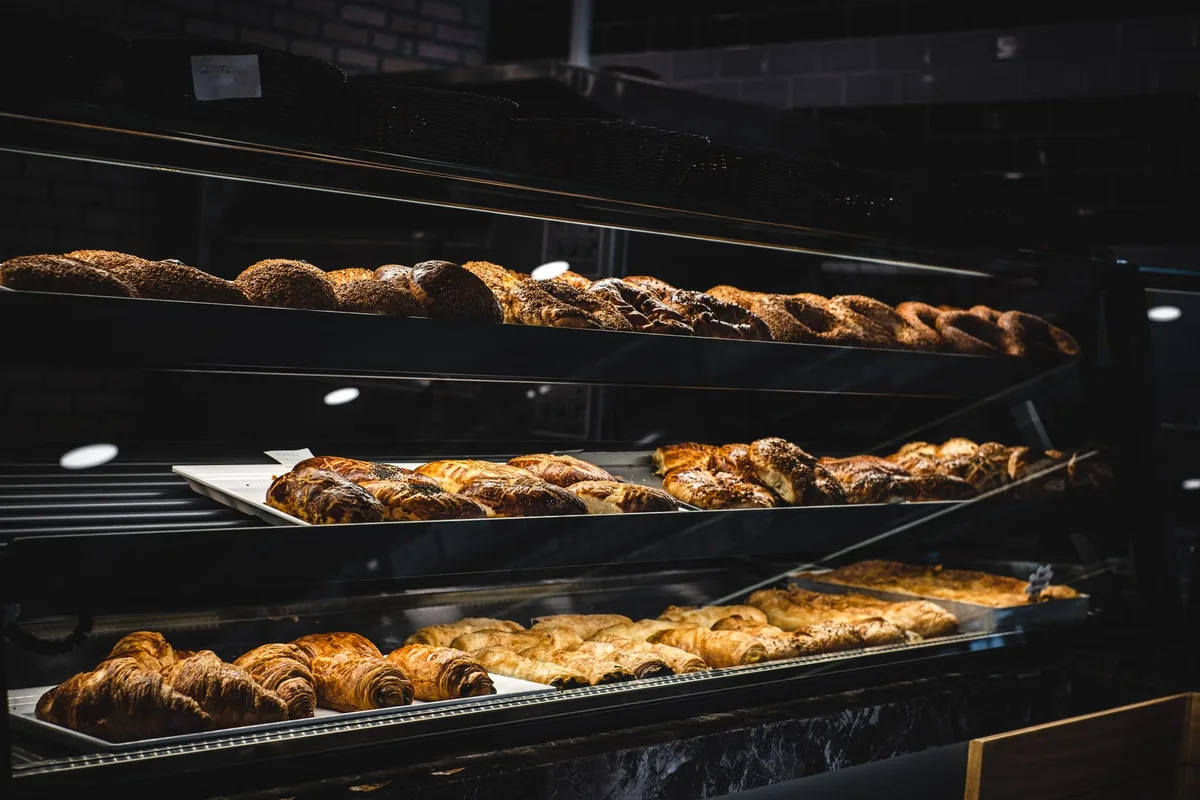
The day's product with prices: the loaf, the sourdough boule, the croissant, the pastries, the cakes. The customer chooses while they queue, and seeing the pastries next to the bread nudges them to take more than the loaf.
Time-of-day combos
The coffee and croissant for £2.50 in the morning, the afternoon treat with a bun. The combo raises the ticket of the one who came just for bread, and the screen switches from breakfast to afternoon by the hour, with nothing for you to touch.
Window and orders
The birthday, christening and celebration cakes with a photo and a QR to order. The cake order is a bakery's high ticket; showing it in the window captures the celebration that would otherwise go to the patisserie next door.
Info area
The clear allergens, the "baked on the premises" and sourdough mark, and your opening times. Telling people you bake it yourself, with sourdough, is what justifies your price against the supermarket's industrial loaf.
The combo raises the ticket,
the order adds the value
A bakery does not live on the loaf alone: it raises the ticket with breakfast, captures the cake order and defends itself from the industrial loaf with the artisan.
The combo turns the loaf into breakfast. The one who comes in for bread also takes the coffee and the croissant if they see the £2.50 combo in view. It is a bakery's easiest cross-sell, and the screen does it on its own, switching from the breakfast offer to the afternoon one by the hour without you putting a sign up and taking it down. The average ticket rises without touching prices.
The cake order is the high ticket that slips away. A birthday or christening cake is worth many loaves, and many customers do not know you make them to order, or go to the patisserie because they do not see it. Showing the cakes with a photo and a QR to order in the window captures the celebration just when the customer has it in mind, and makes your bakery their place for orders.
The artisan defends you from the supermarket loaf. Your sourdough and your on-premises baking against the industrial loaf from the big store do not defend themselves: you have to tell it. The "baked on the premises" and sourdough mark on screen justifies your price and reminds the customer why your bread is worth it and not the supermarket's, which is any local bakery's daily battle.
To be straight with you: we are not an EPOS or ordering system. The screen is the day's product, the combos, the orders and your artisan mark; the order and payment stay on your terminal. Digisini is the screen layer that raises the ticket and captures the order.
The same sandwich, labelled two different ways
depending on whether you hand it over or it sits wrapped on a shelf
Food you make and wrap before the customer asks for it must carry the full ingredient list with allergens emphasised. The identical item, made to order and handed across the counter, does not — the information has to be available, but not printed on the item. Almost every bakery has both categories within a metre of each other, and almost none has thought about the line between them.
It matters because the line moves with your own workflow, not with the recipe. The morning batch of sandwiches wrapped at eight is one thing; the same filling made to order at noon is another. A bakery that grows tends to wrap more, earlier, to cope with the rush — and it crosses that line without anyone deciding to. Knowing where it sits is what stops a busy Saturday from turning into a labelling problem nobody spotted.
And the practical difficulty is not the first label, it is the second. Recipes drift: a supplier changes, a bread is made with a different flour for a week, someone adds sesame to a topping. The printed label is where that drift becomes a false statement, and it is nobody's job to catch it. Whatever else you do, the version of the ingredient list that people rely on should live in one place and be printed from there, not typed twice.
There is a customer-facing half to this that most bakeries treat as a compliance chore and could be selling. «Made here this morning» is the whole argument of an independent bakery against a supermarket aisle, and the ingredient list is the proof — short, recognisable, no improvers. A wall that shows what goes into the sourdough is doing exactly what the label does, except that it persuades instead of just complying.
And the last one is about time rather than ingredients: when things come out. The bread at four, the pastries at seven, what is finished by eleven. Regulars organise their day around those times if they know them and guess if they do not — and a guess that goes wrong twice sends someone to the supermarket, where at least the shelf is predictable. It is the single most requested piece of information in this trade and it changes daily, which is exactly why paper never carried it.
To be straight with you: we display what you upload and we do not check labels or recipes. What must be printed on an item and what may be given on request is a matter for your environmental health team — the point here is only that both rules apply on the same counter, that the line between them moves as you get busier, and that the ingredient list you already keep is also your best argument.
Christmas Eve, forty cake collections
and a queue out past the bus stop
Most days a bakery queue is a line and that works. A few days a year it becomes a crowd, and the crowd is mostly people collecting orders.
The pre-orders are the bottleneck. Somebody wants two croissants, the woman behind wants her yule log and three dozen mince pies boxed up from the back, and the lad after her just wants a sausage roll. Everyone is in one line, everyone is cold, and nobody can tell who was next once the door gets crowded.
Put the collections on a number. A QR code taped to the door: customers picking up an order scan it, press “Take a number” and step aside — or pop to the butcher two doors down. Their mobile counts how many are in front and, after a few calls, guesses the wait from your real pace. When the box is ready you press “Next” on your phone, the screen above the counter flashes “C-012” with a ding-dong, and their handset vibrates if the page is still open. Walk-in sales carry on in the normal line. Regulars without a smartphone? You give them a number yourself. Setting up a QR queue.
Switch it on for the busy days only. Pause the queue on an ordinary Tuesday; bring it back for Christmas, Easter and the Saturday before Mother’s Day.
To be straight with you: it doesn’t take orders or payments, and it can’t tell when the cake is boxed — you call the number. Numbers restart each morning at 5am.
Common questions from
bakery and patisserie owners
Your first screen,
live this afternoon.
Free first screen forever. No credit card. No installer. Offline 48h.
Start free →14-day trial on paid plans, no card · Cancel anytime
Take the button via email
We'll send a 1-click link to create your account whenever you want. No password, no card, no commitment. Your first screen FREE forever.
No spam. Just the link — you decide when to come in.