Pistachio and stracciatella,
on the counter screen
Your customer walks in, looks at the screen and orders the flavour they want without waiting. Instead of a chalkboard that smudges in the heat, the screen shows your available flavours, toppings and seasonal combos. You mark the pistachio as sold out from your phone.
Free first screen forever · No card · Offline 48h
2 scoops £4.50 · lemon sorbet · mango granita
What you put on screen
from day one
Templates ready for artisan gelato shops and neighbourhood ice cream parlours.
Flavour menu with prices and allergens
Today's flavours (pistachio, stracciatella, Belgian chocolate, strawberry, lemon sorbet), cones and tubs with toppings, the month's granitas. When an artisan flavour runs out, mark it from your phone and the screen updates in 2-3 seconds. Your customer sees what's available without asking.
Seasonal combos and promotions
Summer granita + ice cream combo, kids' menu (ice cream + topping + biscuit) and take-home tubs. When the season changes, update the menu from your phone and the screens update automatically. Increase average spend with combos customers don't have to think about.
Allergens, artisan process and takeaway
Allergen information clearly displayed (dairy, nuts, gluten, egg), the artisan gelato seal with natural ingredients and 500 ml and 1 L takeaway tubs with QR to order. Coeliac customers find their sorbet without asking. You meet allergen compliance without effort.
Flavour of the month, events and reviews
The featured flavour of the month with a photo, gelato-making workshops, tasting evenings and your Google reviews with customer photos. Build loyalty without an app, fill workshops on quiet days and turn passers-by into regulars.
The plan your ice cream shop
actually needs
Small ice cream shop with 1 screen above the counter: Starter €9/month. Ice cream shop with counter screen + window display + outdoor terrace: Pro €19/month (3 screens, most popular). Ice cream shop with multiple zones and production kitchen: Business €59/month. Multi-site ice cream chain: Network €199/month. All plans include 14-day trial without card.
No card · Cancel anytime · See all plans
Where the screen goes
in the ice cream shop
An ice cream shop lives on summer, on the flavour of the month and on being artisan. Each screen works one of the three.
Counter and display
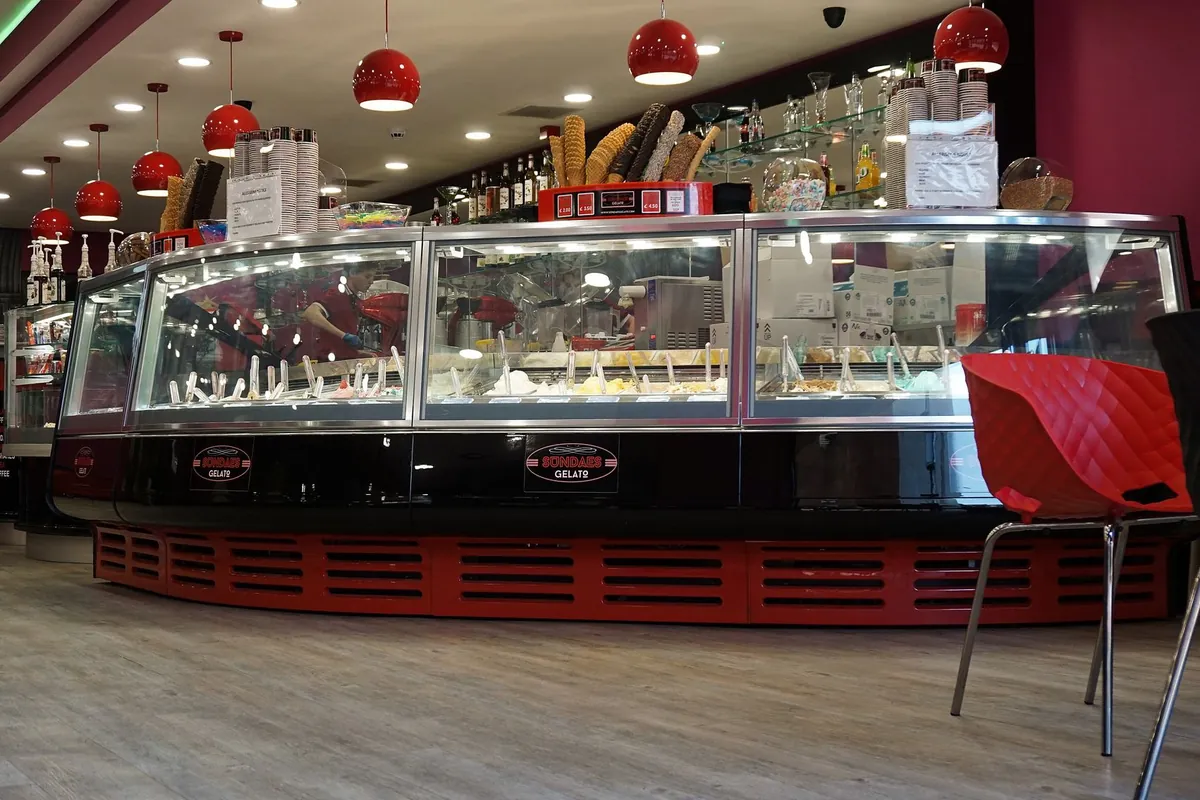
The day's flavours — pistachio, stracciatella, Belgian chocolate, lemon sorbet — with price and allergens. The customer chooses while looking at the display, and a clear menu speeds up the queue in the heat of the rush.
Window
The summer combo, the flavour of the month with a photo and the ice cream cake, to capture the passer-by in the heat. In an ice cream shop impulse is everything; a bright window showing the granita at four in the afternoon brings in the one who was only passing.
Takeaway area
The tubs, the ice cream cakes to order and the packs for home. It is the high ticket that gets lost if it is not seen: the customer who came for a cone takes the family tub because they saw it on screen.
Seating area
The artisan process, the flavour of the month highlighted, the making workshops and your reviews. Telling people your ice cream is artisan — and how it is made — is what sets you apart from the mass-produced counter round the corner.
Capture the heatwave,
and charge for the artisan
An ice cream shop packs the year into a few months and competes with the mass-produced. The screen captures the season and puts the artisan in value.
Summer is the whole year in a few months. May to September is where almost all the takings are made, and the sale is pure impulse. A window showing the granita-and-ice-cream combo in the afternoon heatwave captures the passer-by just when their body wants an ice cream. You change the promo by time of day and by temperature without repainting the chalkboard every day.
By six in the evening the board is lying, and everyone in the queue can see it. Three tubs are empty, one came out of the machine an hour ago, and the printed list still promises all of them exactly as it did at ten. What follows is the worst minute of the shift: someone asks for the one that has run out, and the person serving says no with a queue of nine behind. The board on a screen is edited from the counter as the tub empties — struck through, or gone. Nobody queues eleven minutes for something they cannot have, and the child at the front is not told no at the precise moment he had made up his mind.
Takeaway is the ticket that slips away. The customer who comes in for a £3 cone takes the £12 family tub, or orders the ice cream cake, if they see it. Ice cream cakes and tubs for home are an ice cream shop's high ticket, and they get lost when they are not in view; the screen puts them in front of the craving.
To be straight with you: we are not an EPOS or ordering system. The screen is the menu, the window and the takeaway display; the order and payment stay on your terminal. Digisini is the screen layer that captures the season and puts your ice cream in value.
The person choosing is four foot tall.
The person paying is standing behind them, looking at a different number
In most ice cream shops the decision is made by a child and the payment by an adult, and the two of them want completely different information. The child wants to know which one is the blue one. The adult wants to know what three of those cost before saying yes. Almost every screen in this trade is mounted and written for the adult only, which quietly makes the child's half of the decision slower — and the child's half is the one holding up the queue.
The fix is mostly about height, and it costs nothing at installation time. A display mounted at adult eye level is above a seven-year-old's field of view entirely; they end up looking at the tubs instead, which is fine, except the tubs are behind glass at chin height and half of them are unlabelled from that angle. Bringing the screen down — or putting the picture half of it in the lower third — is a decision made once, on the day the bracket goes up, and it is expensive to change afterwards because the cable is already inside the wall.
The content follows the same split. Big pictures and colour names on the lower part, prices and sizes on the upper part. Not because children cannot read prices, but because they are not the ones deciding on price, and mixing both jobs into one dense layout means neither person finds their bit at a glance. It is the same reason a menu at a counter and a menu at a table are not the same document.
And there is a queue argument hiding in this. A family of four that has decided before reaching the counter takes about ninety seconds to serve. The same family deciding at the counter takes three or four minutes, and on a hot Saturday that difference is what turns a queue into a queue that people leave. Anything readable from ten feet back in the line — the flavours, the sizes, the picture — is doing that work, and it does not have to be clever to do it.
Worth being straight about the limit: none of this makes a child choose faster on their own. It removes the part where they cannot see what the options are, which is a smaller problem than it sounds until you watch a queue for an hour. And if the shop's customers are mostly adults buying for themselves, the whole argument does not apply — mount it at eye level and ignore this section.
Thirty degrees on the seafront
and the queue is standing in full sun
On an ordinary afternoon a line at the cabinet is fine. On the first hot bank holiday it reaches the promenade, and people give up.
The queue you lose is the one outside. A family with a pushchair sees twenty people baking on the pavement and walks on to the kiosk at the end of the pier. They would have waited; they just would not stand in the heat to do it.
A QR code in the window lets them wait in the shade. They scan, tap “Take a number”, and sit on the sea wall with the kids. The mobile tells them how many groups are in front and roughly how long, judged from how quickly your scoopers are really getting through people. When you press “Next”, the TV inside shows “G-031” with a ding-dong, and their phone buzzes if the page is still open. The flavour board keeps running beside the number, so whoever stays inside decides before reaching the glass. Grandparents without a smartphone ask at the till and join the same line. How the QR queue is set up.
Keep it for the peaks. On a quiet weekday a straight line is quicker; pause the queue and bring it back when the sun comes out.
To be straight with you: if they lock the phone in their pocket, it won’t buzz. And it can’t take orders or payments — it only keeps their place.
Common questions from
ice cream shop owners
Your first screen,
live this afternoon.
Free first screen forever. No credit card. No installer. Offline 48h.
Start free →14-day trial on paid plans, no card · Cancel anytime
Take the button via email
We'll send a 1-click link to create your account whenever you want. No password, no card, no commitment. Your first screen FREE forever.
No spam. Just the link — you decide when to come in.